Trigger
Something happens. It may be obvious, such as an argument, payday or loneliness. It may be subtle, such as poor sleep, hunger, shame or feeling stuck.
Work Wise ADHD
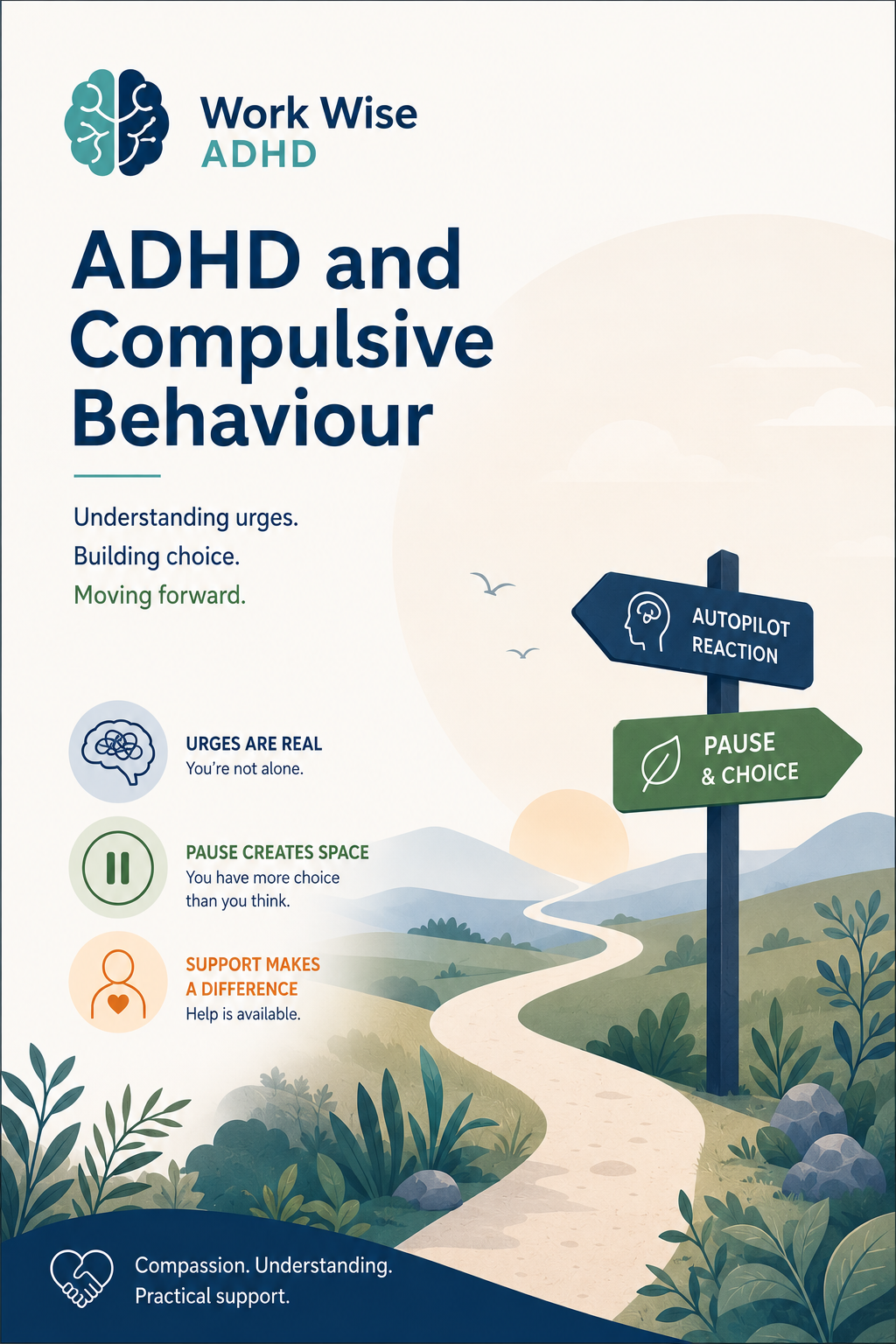
Understanding urges, loops and the first pause
Many adults know that a behaviour is causing problems, but still feel pulled back to it.
They may promise themselves they will stop drinking, stop scrolling, stop gambling, stop spending, stop binge eating, stop using substances, stop overworking or stop chasing the next intense thing.
They may mean it completely in the moment. Then the urge comes back, the behaviour happens again, and shame often follows.
“Why do I keep doing this when I know it is hurting me?”
The answer is not simple. It is not about weakness, laziness or a lack of willpower.
For some adults, compulsive behaviours are linked to the way ADHD affects regulation. This may include attention, emotion, motivation, impulse control, stress, boredom, reward and the ability to pause before acting.
This leaflet is designed to help adults understand those patterns more clearly.
Key facts
Research findings vary between studies and populations. They should be understood as broad indicators of increased risk, not as predictions for any individual person.
ADHD does not mean someone will develop an addiction. ADHD does not mean someone lacks self-control. ADHD does not excuse harmful behaviour.
But ADHD can make some adults more vulnerable to getting stuck in compulsive patterns.
Research suggests that ADHD is often found alongside substance use disorders in adults. The overlap varies by population, setting and diagnostic method, so it should not be used to predict risk for any individual person.
This does not mean ADHD causes addiction. It does show that the overlap matters.
For many adults, understanding ADHD helps explain why certain behaviours became so powerful, especially when those behaviours offered fast relief, stimulation, escape, confidence or control.
When someone is struggling with a compulsive behaviour, the focus is often on stopping. Stopping may be necessary, especially when a behaviour is causing harm.
But for many adults with ADHD, stopping becomes much harder if they do not understand what the behaviour was doing for them in the first place.
“What need is this behaviour trying to meet?”
The behaviour may be serving a purpose. Understanding that purpose does not make the behaviour safe. It does not remove responsibility. But it does create a starting point for change.
ADHD is often described as a difficulty with attention. That is only part of the picture.
For many adults, ADHD affects the ability to regulate:
Everyday life can feel inconsistent. Some days, a person may feel capable, focussed and full of ideas. Other days, even simple tasks can feel impossible.
When the brain feels under-stimulated, overwhelmed, restless or emotionally flooded, it naturally looks for something that changes the state quickly. That is where compulsive behaviours can become powerful.
Dopamine is involved in motivation, reward, learning and the brain’s ability to notice what feels important.
It is often said that ADHD is caused by “low dopamine.” That is too simple.
“ADHD involves differences in the brain systems that support motivation, reward, attention and impulse control. Dopamine is one part of that picture.”
For some adults with ADHD, ordinary rewards may not feel strong enough, especially if they are delayed, repetitive or boring.
A future reward, such as better health, saving money, finishing a task or avoiding consequences, may not feel powerful enough in the moment. But a quick reward can feel immediate and compelling.
The brain learns: “This changes how I feel.” Once the brain learns that, it may keep pulling the person back towards the behaviour, even when part of them desperately wants to stop.
A compulsive behaviour is not just something someone enjoys. It is a behaviour that starts to feel difficult to control, even when it creates consequences.
It may involve substances, such as alcohol, nicotine or drugs. It may also involve behaviours, such as gambling, gaming, shopping, social media, binge eating, pornography, risky sex, overworking, compulsive exercise or risk-taking.
It is important not to label every repeated behaviour as an addiction.
“Is this behaviour becoming difficult to control, causing harm, or taking me further away from the life I want?”
Work Wise Insight
Many adults spend years trying to understand why they struggle with alcohol, drugs, gambling, shopping, social media or other compulsive behaviours. For some, an ADHD diagnosis provides the missing piece of the puzzle.
Many compulsive behaviours follow a loop. The behaviour may look different from person to person, but the pattern is often similar.
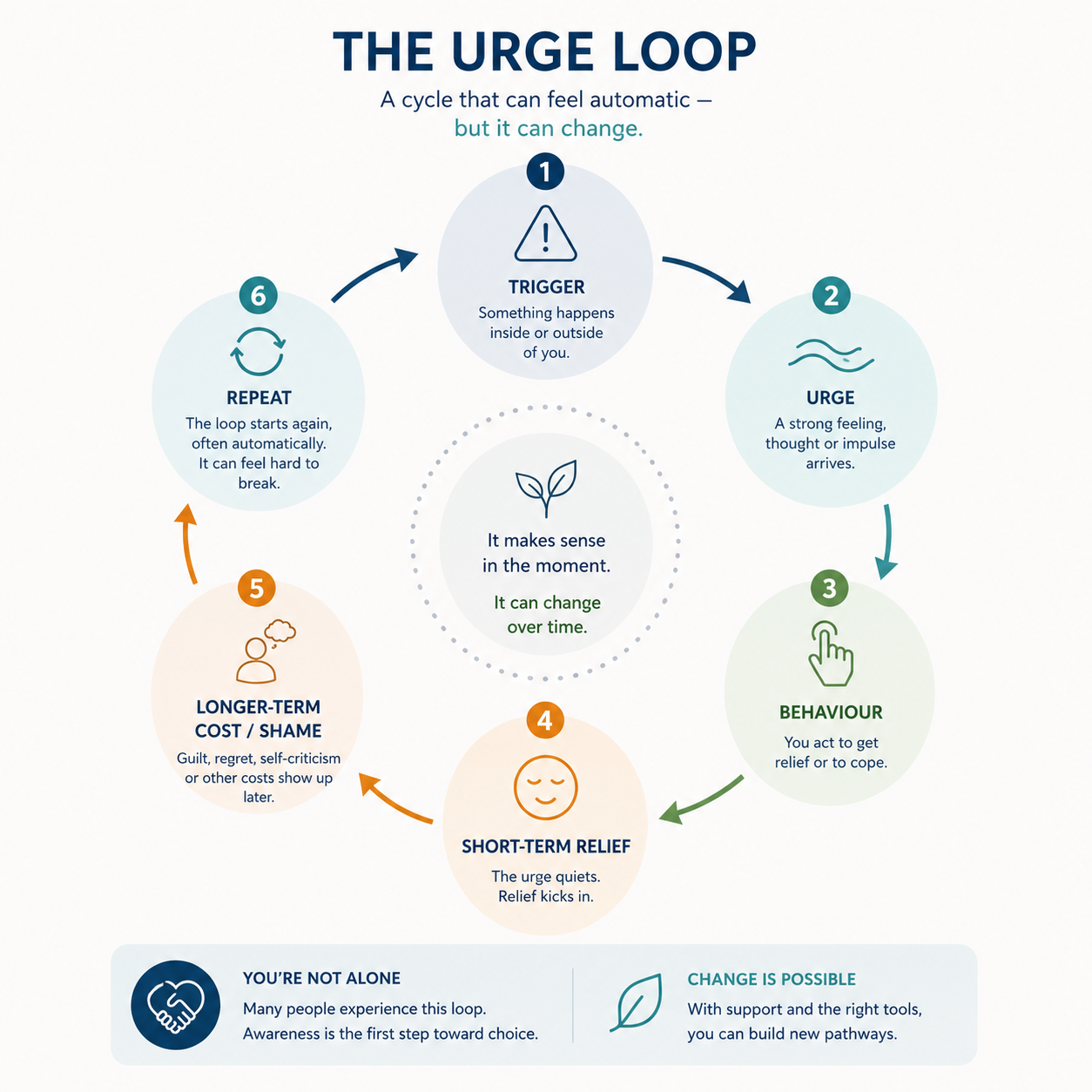
Something happens. It may be obvious, such as an argument, payday or loneliness. It may be subtle, such as poor sleep, hunger, shame or feeling stuck.
The brain starts searching for a fast solution. The urge may feel like pressure, craving, excitement or urgency.
The person reaches for the quickest available way to change how they feel. They drink, use, gamble, spend, scroll, binge, overwork or take a risk.
For a while, it may work. The person may feel calmer, more confident, more focussed, more alive, more numb or more in control.
The cost may arrive later. It may be financial, emotional, physical, relational or professional.
After the behaviour, shame often appears. Shame increases distress, and distress can become the next trigger.
Work Wise Insight
Many adults with ADHD do not have a motivation problem. They have a regulation problem. Understanding the loop gives people something more useful than shame: a place to intervene.
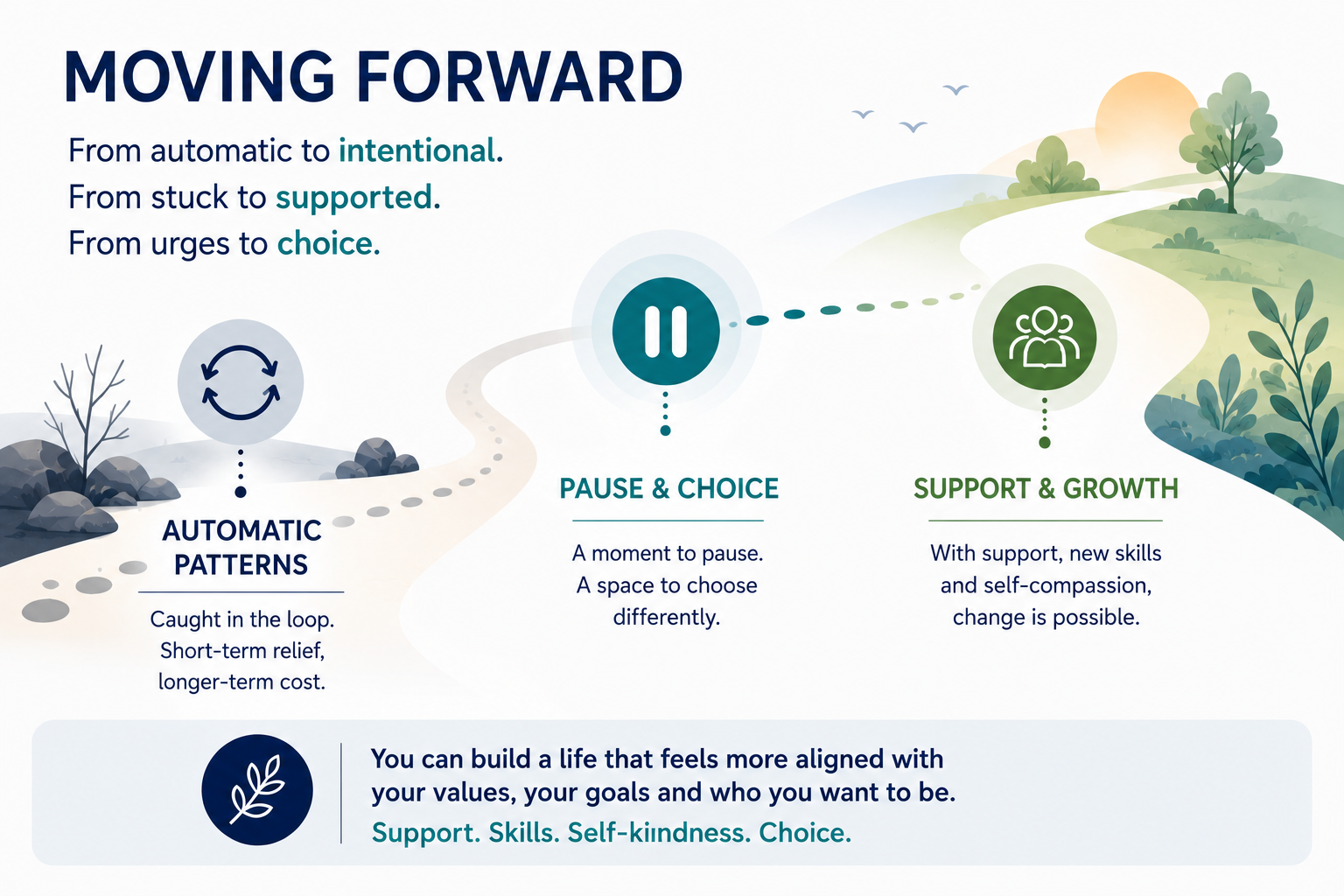
The first aim is not to fix everything immediately. The first aim is to slow the loop down.
Trigger, urge, pause, choice
The pause may be tiny at first. Ten seconds. One breath. One note in a tracker. One message to someone safe. One glass of water. One walk around the room. One decision to delay rather than act immediately.
The pause matters because it teaches the brain that an urge is not an instruction. An urge is a signal. It can be noticed. It can be named. It can be delayed. It can be understood.
When an urge appears, try saying:
“This is an urge.”
Not: “I am failing.” Not: “I am weak.” Not: “I am broken.” Not: “I have no control.”
That small shift creates distance between the person and the behaviour. The urge is something happening in the body and brain. It is not the whole person.
The aim is not to answer perfectly. The aim is to interrupt the automatic pattern.
Was there a trigger, such as stress, boredom, rejection, conflict, tiredness, loneliness, money, pain, criticism or overwhelm?
Angry, restless, ashamed, flat, excited, anxious, numb, lonely or overstimulated?
Am I trying to feel calmer, more focussed, more confident, more in control, less bored, less sad or less rejected?
Relief, stimulation, comfort, escape, connection, achievement or excitement?
Sleep, money, trust, health, safety, confidence, work, relationships or recovery?
Many people cannot track an urge while it is happening. That is normal. The urge may feel too strong. The person may only be able to reflect afterwards.
That still counts. Looking back teaches the brain to recognise patterns earlier next time.
This is not about self-criticism. It is about collecting clues.
Some people worry that explaining ADHD and compulsive behaviour might sound like making excuses. It should not.
Understanding is not the same as excusing. A person can take responsibility for behaviour while also recognising the factors that made the behaviour more likely.
Shame says: “I am bad.” Understanding says: “There is a pattern here, and patterns can be changed.” That difference matters.
Many people are told what to stop. But if a behaviour has been helping someone regulate, removing it can leave a gap.
The brain still needs relief. The body still needs soothing. The person still needs stimulation, connection, confidence, rest, meaning or comfort.
“How can I meet the same need in a safer way?”
This is where recovery becomes more than stopping. It becomes building.
“There are other ways to change how I feel.”
Self-awareness is valuable, but it is not always enough.
Professional support is important if a substance or behaviour:
Do not suddenly stop heavy alcohol use, benzodiazepines or some other substances without medical advice. Withdrawal can be dangerous.
If there is immediate danger, seek emergency help.
Some adults worry that a history of addiction means they can never receive ADHD medication. The reality is more individual.
Substance use, addiction risk, stability, medication choice, safeguarding, physical health and prescribing governance all matter.
For some people, active or unstable substance misuse may complicate prescribing and require specialist support before ADHD medication can be considered safely. For others, ADHD treatment may form part of a carefully managed plan.
This decision should always be made with an appropriately qualified clinician. This leaflet does not provide medication advice.
Work Wise ADHD and Titrio Focus may explore future tools that help adults notice patterns in urges, triggers and compulsive behaviours without judgement.
This would be separate from medication advice, addiction treatment or crisis support. The purpose would not be to diagnose addiction, replace treatment or tell someone what to do.
A future behaviour-tracking tool could help people notice:
The aim would be to help adults understand their own patterns and prepare for better conversations with healthcare professionals, recovery workers or support services.
A helpful future tool would not simply ask: “Did you do the behaviour?”
It would ask: “What was happening before the urge?”
Because that is where understanding begins.
Work Wise Insight
Recovery is not just about removing a behaviour. It is about understanding what the behaviour was helping you achieve and finding safer ways to meet the same need.
Many adults with ADHD have spent years blaming themselves for patterns they did not understand. They may have been told they are careless, impulsive, unreliable, too much, not enough, lazy, dramatic or weak.
But many were trying to regulate a brain and body that felt difficult to manage.
Understanding ADHD does not erase the past. It does not remove consequences. It does not make change easy. But it can change the question.
“What is happening in this loop, what need am I trying to meet, and what support would help me choose differently?”
Choose one urge. Do not try to fix everything. Just notice one loop.
The aim is not perfection. The aim is awareness. Awareness creates the pause. The pause creates the possibility of choice.
Work Wise ADHD is UK-based. If you are worried about alcohol, drugs, gambling, compulsive behaviour, withdrawal, relapse risk or safety, please seek support from an appropriate professional or support service.
This leaflet draws on research and guidance about adult ADHD, substance-use vulnerability, gambling support and urgent help. This resource is educational and should not be used to predict risk for any individual person.
This leaflet is for general educational information only.
It is not medical advice, addiction treatment, diagnosis, therapy, prescribing advice, medication decision support, relapse prevention planning, crisis support or emergency care.
If you are concerned about alcohol, drugs, gambling, compulsive behaviour, withdrawal, relapse risk or your safety, please seek support from a qualified healthcare professional, your GP, NHS 111, a local drug and alcohol service, a gambling support service, or emergency services if there is immediate risk.